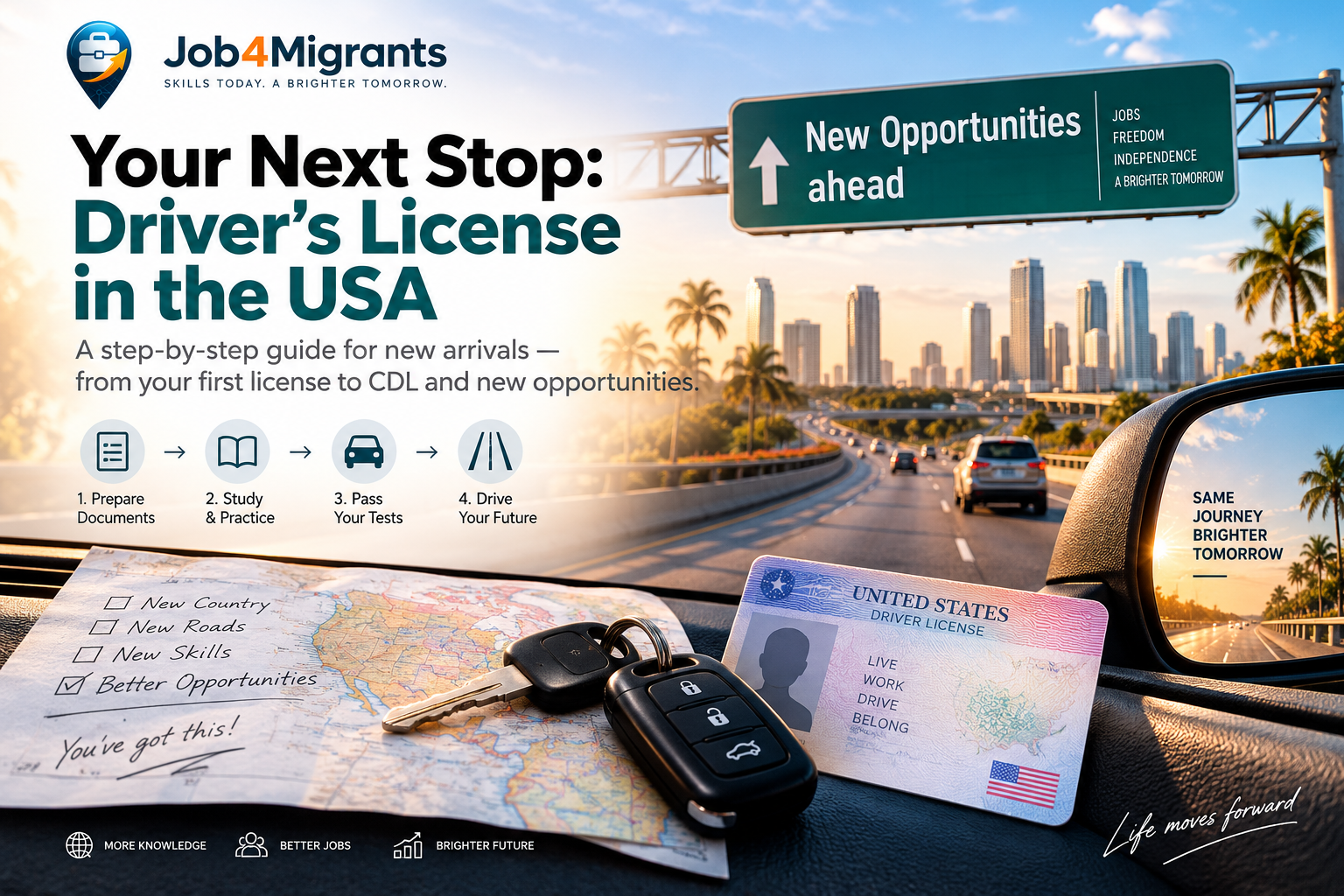
Where to start with a regular license and when to consider a CDL
Facts checked on October 5, 2026.
A promising job may be a 30-minute drive from home, with a shift that starts before the first bus arrives. Transportation can become a concern before you even get to the interview. That makes getting a driver’s license a practical task to consider early after moving: it can help you commute independently, take your child where they need to go, and plan your day.
How urgently you need a license depends on your city, neighborhood, and daily routes. Start by checking your commute and calculating transportation costs. If you plan to drive, learn the local rules before your first trip.
This guide helps adult newcomers plan how to get a regular driver’s license in the United States. It also covers study strategies and explains the next steps toward a commercial driver’s license for anyone considering driving as a career.
A regular driver’s license or a CDL
For everyday trips in a passenger car, you need a regular driver’s license, often abbreviated as DL. License class names vary by state. On your state agency’s website, choose the instructions for first-time applicants or for drivers who already hold a license from another state or country. [1] [2]
A commercial driver’s license, or CDL, is required to operate certain heavy vehicles and for some passenger and hazardous materials transportation. The license class depends on the vehicle and the type of transportation involved. [3]
If your immediate goal is to commute and handle everyday errands, start with a regular license. If you are interested in trucking, check CDL requirements early so you can assess your eligibility for training and the likely costs.
What to compare | Regular license DL | Commercial license CDL |
|---|---|---|
Driving needs | Everyday trips in a passenger car, including commuting to work. | Operating certain heavy vehicles and some passenger and hazardous materials transportation. |
Where to check requirements | Your state driver licensing agency. | Your state driver licensing agency and FMCSA. |
Find the rules for your state
Apply through the driver licensing agency in the state where you live. Eligibility, documents, and procedures vary. A state-issued license lets you drive across the United States, but if you move permanently to another state, check its rules for transferring your license. [4]
Start with the official USA.gov directory of state motor vehicle services. Your agency may be called the DMV, DPS, or something else. Look for sections such as Driver License, New Residents, and First Driver License. [5]
Before booking an appointment, find answers to these five questions:
- Which requirements apply to someone your age and with your documents?
- What must you bring to prove your identity and residency?
- Which rules apply if you already have a foreign driver’s license?
- Do you need to complete a course, get a learner’s permit, and take all the tests?
- What deadline applies to new residents?
Save the official document checklist and application instructions. Advice from a friend in another state may not fit your situation.
If you already have a foreign driver’s license
Check two separate issues: whether you may drive temporarily with your current license, and how to obtain a local one. Rules for visitors may differ from those for people who have become state residents. Some states also require an International Driving Permit, which is used together with your national driver’s license. [4]
Ask whether you must take the knowledge and road tests. Exemptions depend on the state and where your existing license was issued. Bring your valid license to the appointment. Being allowed to drive during a visit does not mean you can use that license indefinitely after moving. [4] [1]
Prepare your documents
Choose the checklist that matches your situation on the official website. First-time applicants, drivers moving from another state, and applicants using foreign documents may follow different instructions. [1] [2]
You will generally need to prove your identity and state residency. Check which documents are accepted, how many proofs of address you need, and whether electronic statements are allowed. If your name differs across documents, ask in advance how to document a name change. [2]
Requirements involving a Social Security number, or SSN, and immigration documents are not the same nationwide. If you do not have an SSN, check your state’s rules. The absence of a number alone does not provide a universal answer about eligibility for a regular license. [1] [6]
Before your visit, check the spelling of your name, document expiration dates, and requirements for originals or translations. Find out whether you can complete the application in advance and book the right service. This can help you avoid arriving with a document missing.
How to get a regular driver’s license
In most first-time applications, the process involves a document review, a vision screening, a knowledge test, and a driving skills test. Your state determines the exact sequence, required training, and any test exemptions. [1] [2] [7]
Check the driver education requirements
Find out whether you need an approved course for new drivers. Requirements may depend on your age and previous license. Rules differ even for adult applicants, so check that a course meets your needs before paying for it. [1] [7]
Study the handbook and prepare for the knowledge test
Your main study resource is your state’s official Driver Handbook or Driver Manual. It explains road signs, right-of-way rules, speed limits, and how to respond to traffic situations. You can usually find it on the state licensing agency’s website. [2] [7]
Read it in small sections and check your understanding with practice questions. Spend extra time on topics where you can select the correct answer but cannot yet explain the rule.
Before booking, check the official test format: where it is offered, how many questions it contains, the passing score, and any time limit. Also check which languages are available. A study website’s language does not determine the language of your state’s official exam. [2] [7]
Arrange driving practice
Find out what authorization you need to practice on public roads. Many states issue a learner’s permit or instruction permit. Its conditions specify who must accompany you and which restrictions apply. Check these requirements before your first practice drive. [2] [7]
If you have driven in another country, ask an instructor to assess your skills against local requirements. Pay particular attention to observing traffic, stopping, changing lanes, and following the examiner’s instructions.
Prepare for the road test
Decide in advance which vehicle you will use for the road test. Check the requirements for the vehicle, registration, insurance, and accompanying driver. Do not assume the testing office will provide a car. [2] [7]
Once you have met the requirements, complete the licensing process with your state agency. Check the name, address, license class, and restrictions on the document you receive.
How to study with Job4Migrants
Open the Job4Migrants driving practice tests, choose regular licenses under DL, and check the available states. Use the relevant section alongside your state’s official handbook. [8]
Explanations in a language you understand can make the rules easier to learn, especially at the beginning. If you will take the official exam in English, gradually add English road terminology and question wording to your study routine.
Try this study routine:
- Read one topic in the official handbook.
- Answer practice questions on that topic.
- After a mistake, read the explanation and review the relevant rule.
- Write down unfamiliar words that made the question harder to understand.
- Move on to a mixed practice test once you can confidently explain your answers.
Do more than memorize which answer to select. Ask yourself, “What would I do if I encountered this situation on the road?” If you are not sure, revisit the topic.
Your practice score can help you assess your preparation. To obtain a license, you still need to pass the required official tests and meet your state’s requirements. Practice questions may differ from those on the official exam.
How much time and money to plan for
There is no single nationwide price or timeline for getting a driver’s license. Build your budget around agency fees and possible additional costs: a required course, driving lessons, a vehicle for the test, and retakes. Find current fees on your state’s official website.
Estimate the timeline by stage: gathering documents, finding an appointment, studying, and taking tests. If a school or instructor offers a package, ask for a list of what is included and what costs extra.
You can start preparing before buying a car. Arrange a suitable vehicle for practice and the road test separately, and meet the local requirements.
When to consider a CDL
A regular driver’s license can be the first step toward working as a truck or bus driver. To practice with a Commercial Learner’s Permit, or CLP, you need a valid driver’s license issued by the same jurisdiction that issued the CLP. [9]
Start with the work you want to do. A typical tractor-trailer generally calls for Class A, while a heavy single-unit truck or large bus generally falls under Class B. CDL Class C covers certain passenger and hazardous materials operations. Choose the exact class and endorsements based on the vehicle’s specifications and the type of transportation. [3]
Check your eligibility before paying a school
New federal rules for non-domiciled CLPs and CDLs took effect on March 16, 2026. As a general rule, eligible foreign applicants in this category must hold H-2A, H-2B, or E-2 status; an Employment Authorization Document, or EAD, alone is not enough. U.S. citizens and lawful permanent residents with a green card can obtain a standard CDL in their state of domicile if they meet the other requirements. [10]
These restrictions concern commercial CLPs and CDLs. Eligibility for a regular driver’s license is determined separately under state rules. [4] [10]
Before paying for training, check how the current FMCSA guidance applies to your circumstances and confirm the requirements with your state licensing agency. Ask whether it is currently issuing the type of CLP or CDL you need. Authorization to work and eligibility for a commercial license are separate questions. [10]
The federal minimum age for a CLP is 18. Regular work in interstate commercial transportation generally requires drivers to be at least 21. If you are 18 to 20, check separately which intrastate opportunities your state allows. [9] [11]
Understand the training and testing stages
The path to a CDL typically involves checking document and medical requirements, passing knowledge tests, obtaining a CLP, completing training, and taking the skills test. First-time Class A and Class B applicants must complete Entry-Level Driver Training, or ELDT, with a provider listed in the FMCSA Training Provider Registry. Online practice tests can help you review the theory, but they do not replace this training. [12] [13]
At least 14 days must pass after the initial issuance of your CLP before you take the skills test, and the required training must also be complete. This is a minimum waiting period, not a promise that you can earn a CDL in two weeks. [9] [12]
The skills test includes a vehicle inspection, basic vehicle control, and on-road driving. It is conducted in English without an interpreter. [14]
For independent review, use the Job4Migrants CDL practice tests. Sections cover general knowledge, air brakes, combination vehicles, and pre-trip inspection. Choose topics that match your intended license class and refer to your state’s CDL Manual. [15]
Connect your preparation with your job search
Even before you get your license, browse jobs on Job4Migrants and read the requirements in listings that interest you. To find driving work, try search terms such as driver, delivery driver, CDL A, or CDL B. [16]
Compare the required license class, experience, and schedule with your plans. For trucking jobs, ask whether you will be home daily, how pay is calculated, and which expenses you will have to cover.
If you choose a job that does not involve driving, check how you will reach the workplace before your shift starts. This will help you decide how soon you need a license and a car.
Start with two actions: save your state’s official document checklist and read one topic in the Driver Handbook. Then use practice questions to check how well you understood it.
Rules and procedures can change. Before applying, confirm the requirements with your state licensing agency. For a CDL, also check the current FMCSA rules.
Sources
- Texas DPS — Applying for a Texas Driver License
- California DMV — Driver’s Licenses
- FMCSA — CDL Classes and Endorsements
- USA.gov — Driving in the U.S. If You Are Not a Citizen
- USA.gov — State Motor Vehicle Services
- California DMV — AB 60 Driver’s Licenses
- New York DMV — Driver Licenses
- Job4Migrants — DL and CDL Practice Tests
- 49 CFR 383.25 — CLP Requirements and the 14-Day Waiting Period
- FMCSA — Non-Domiciled CDL 2026 Final Rule FAQs
- 49 CFR 391.11 — Driver Age and English Language Requirements
- FMCSA — How Do I Get a Commercial Driver’s License
- FMCSA — Entry-Level Driver Training
- 49 CFR 383.133 — Skills Test Methods and Language Requirements
- Job4Migrants — CDL Practice Tests
- Job4Migrants — Job Listings