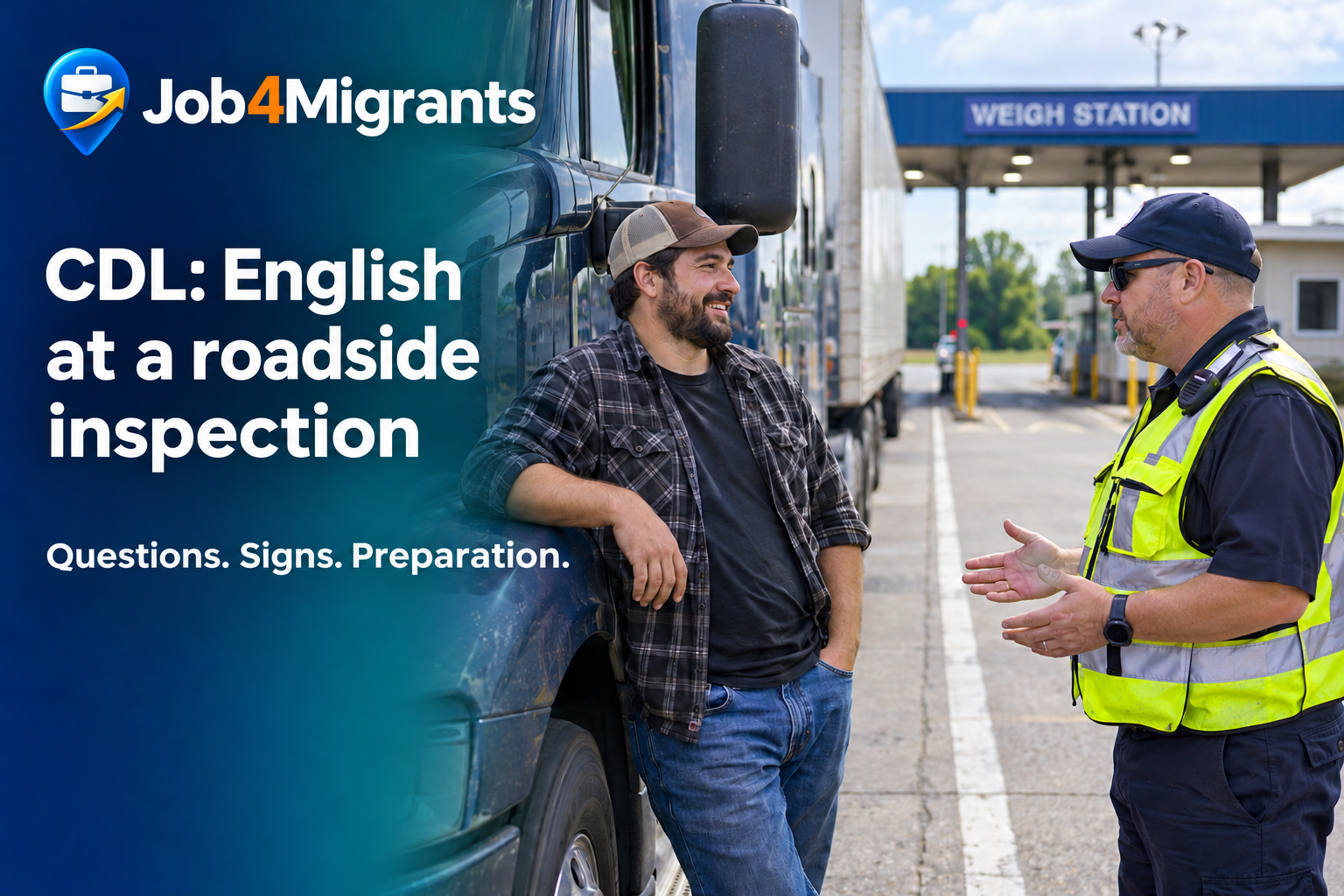
During a roadside inspection, a driver needs to understand questions, explain the trip and follow the inspector’s instructions. Memorizing “Yes, sir” is not enough. Useful preparation starts with the English you use every day: routes, cargo, working hours, documents and road signs.
Below are practice questions and short sample answers. This material helps you build understanding and speaking skills. It is not an official FMCSA test or a guarantee of passing an inspection. All cities, times and names in the examples are illustrative. During an inspection, answer only about your actual trip.
What is assessed and why it matters
The federal requirement in 49 CFR § 391.11(b)(2) requires sufficient English proficiency to communicate, understand road signs and signals, answer official inquiries and make entries in records. This article covers federal requirements for interstate commercial transportation. Whether the rules and any exceptions apply to a particular trip must be checked separately.
Under the FMCSA policy dated April 16, 2026, the inspector begins communicating in English. If the initial contact gives reason to doubt that the driver understands instructions, an English Language Proficiency (ELP) assessment follows: first an interview, then an assessment of road-sign comprehension, including electronic message signs. If the interview result is unsatisfactory, the assessment does not proceed to the sign portion.
During the language interview, do not rely on an interpreter, an app or a card with prepared answers: FMCSA policy excludes these aids from that part of the assessment. After a successful language assessment, the inspector may choose other communication methods to safely complete the rest of the inspection.
An ELP violation can result in an out-of-service (OOS) order, prohibiting further operation of a commercial vehicle until the cause is addressed. Specific exceptions exist, including certain trips operating only within the U.S.–Mexico border commercial zones and drivers exempt from Part 391 requirements. OOS itself does not automatically cancel a CDL: a driver-qualification proceeding is a separate process. See the FMCSA FAQs, updated October 6, 2026.
8 questions to practice before a trip
FMCSA recommends that carriers assess English using topics such as routes, working hours, driver’s licenses, shipping documents and equipment. The editorial team prepared the questions below using this guidance for carriers. An inspector may use different wording and ask follow-up questions.
1. Where are you coming from and going?
Question: “Where are you coming from, and where are you headed?”
Sample answer: “I picked up this load in Chicago, Illinois. I’m delivering it to Dallas, Texas.”
Meaning: Be ready to explain your starting point and destination.
2. What cargo are you carrying?
Question: “What are you hauling?”
Sample answer: “I’m hauling packaged furniture.”
Meaning: “Hauling” means transporting a load.
Be able to name your actual cargo and find its description in the documents. Do not invent the contents, weight or number of packages.
3. Which carrier do you work for?
Question: “Which carrier are you driving for?”
Sample answer: “I’m driving for [carrier name].”
Meaning: Give the name of the carrier you are driving for.
4. Can you show your driver’s license?
Question: “May I see your driver’s license?”
Sample answer: “Here is my commercial driver’s license.”
Practice understanding questions about your name, the issuing state and the expiration date. License validity and authorization to drive a particular vehicle are checked separately from English proficiency.
5. When did you start work today?
Question: “What time did you go on duty today?”
Sample answer: “I went on duty at six a.m.”
Distinguish on-duty time from driving time. Your answer should match your records. Clarify the time zone when relevant.
6. How long have you driven today?
Question: “How many hours have you driven today?”
Sample answer: “I’ve driven for three hours today.”
The number is only a practice example. Do not adjust your answer to match it or guess what the inspector would like to hear.
7. Show the shipping documents
Question: “Can you show me the shipping papers for this load?”
Sample answer: “Here are the shipping papers for this load.”
Check beforehand where to find the shipper, consignee, delivery address and cargo description. Hazardous materials are subject to additional requirements; this short guide does not replace them.
8. How do you show your hours-of-service records?
Question: “Can you show me your hours-of-service records?”
Sample answer: “Yes. I can display my records on the ELD.”
This answer applies only if you actually use an ELD and know how to do this. Practice opening records on your device and transferring data as instructed. Knowing the phrase does not replace properly maintained records. FMCSA explains ELD data transfer and display.
If you did not catch the question
- “Could you repeat the question, please?”
- “Could you speak more slowly, please?”
- “Do you mean my driving time or my on-duty time?”
- “I don’t understand that instruction. Could you explain it again?”
These phrases can help clarify what you heard, but they do not replace the ability to understand English. Do not automatically say “yes” or carry out a maneuver you do not understand. First make sure you understand the instruction.
Road signs: explain what you need to do
When practicing, focus on understanding the required action, not just translating words. Here are three practice examples:
- ROAD CLOSED. “The road is closed. I must not continue on that road.”
- NO TRUCKS. “Trucks are not allowed on this road.”
- RIGHT LANE CLOSED AHEAD. “The right lane is closed ahead. I need to merge safely when permitted.”
Also study height and weight restrictions, truck-specific signs and electronic messages. Check numbers and units, and compare them with your vehicle’s specifications. Use images from the official FHWA MUTCD for practice. These three examples are not a complete list of signs that may be assessed.
How to practice effectively
- Use your actual trip. State your route, cargo and carrier in English. Do not post documents, personal data or commercial information in comments.
- Ask for different wording. “Where are you headed?” and “What is your destination?” both ask about your destination. Learn to recognize the meaning rather than the word order.
- Add a follow-up question. After your delivery answer, ask your practice partner to request the address or time. Answer from your documents rather than from memory of this article.
- Practice listening and speaking without prompts. First work through the meaning, then put the explanation away. Practice in short sessions with a teacher or someone who speaks English confidently.
- Check that you can perform the actions. Can you find a document, open your ELD and understand an instruction about inspecting equipment? If not, ask your carrier to arrange training before your next trip.
Learning English takes work. Practical situations on the job give you a clear starting point: you can see which words and skills you already know and which need more practice.
What to remember
Good English does not remove the need to check your CDL, documents, hours of service, cargo and vehicle condition. If you receive an OOS order, do not continue driving in violation of it. Contact your carrier and find out how to address the cause and what to do next.
To review terminology and inspection topics, try the Job4Migrants CDL practice tests. They cover CDL knowledge and are not an official roadside English assessment.
If you are considering a new job, compare carriers’ English and training requirements in truck driver job listings. Before agreeing to a trip, ask who helps drivers learn the ELD and prepare for inspections. Find more career resources in the trucking career section.
For discussion: Which wording from an inspector was hardest for you to understand? Share it without names, document numbers or details about a specific load. Your experience can help other drivers choose what to practice.
Checked November 10, 2026. General educational material, not legal advice or an official FMCSA exam. Rules, exceptions and the circumstances of an individual inspection may vary.